Insight / signal
AI opens the sale. It doesn't close it.
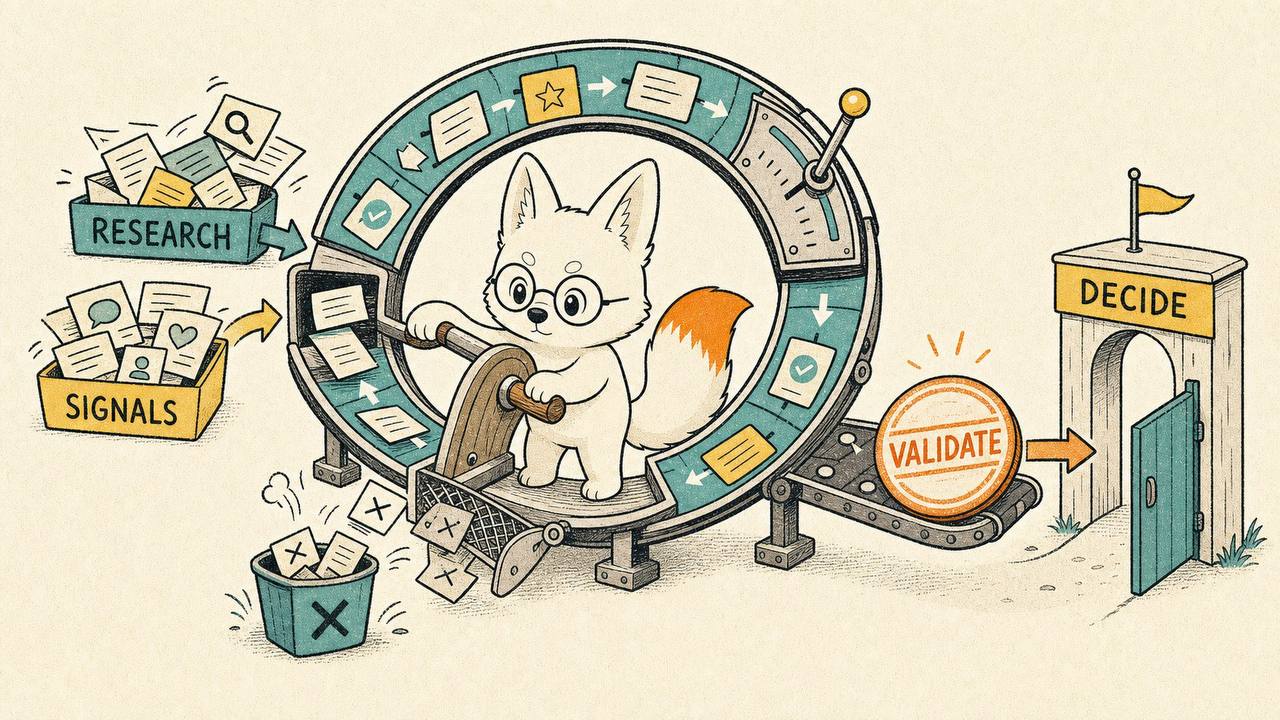
AI is taking over research and shortlisting, but humans, reviews and price still decide whether the shortlist is trusted.
Two years ago, a UK buying decision started with a blank Google box. Today, for a fast-growing share of people, it starts with a blank chat box.
That sounds like a small change. It isn’t.
When the journey began on Google, you could fight for it. You ranked, you bid, you earned the click. The buyer saw a page of options and made up their own mind. Now a machine reads the page for them, picks a handful of names, and hands back a tidy answer. If your name isn’t in that answer, you were never in the running. The buyer doesn’t know you lost. They don’t know you existed.
This is the shift the UK data has been quietly confirming all year. Here’s what it actually says, and the part most people get wrong.
First, the speed
Start with adoption, because the pace is the story.
Adyen’s 2026 Retail Report found the share of UK shoppers using AI assistants to shop more than doubled in a year, from 12% to 28%. Omnisend, surveying just over a thousand British shoppers in June, put the broader figure at 55%: more than half of us now use generative AI somewhere in an online purchase. A third use it for research. A quarter use it for recommendations. Of the people using it, 53% say it saves them time and 51% say it cuts through the noise.
Two years ago that broad number sat near 30%. The line is going one way, and quickly. 70% of UK consumers now expect AI shopping assistants to be a normal part of buying online.
Adoption that moves this fast doesn’t ask permission. It just becomes the default while everyone’s still arguing about whether it’s any good.
The front door moved
Here’s where it bites.
Yext found 19% of UK consumers now start a product search inside an AI tool, against 38% who still begin on a traditional search engine. Two years ago the AI number was a rounding error. Capgemini found 58% of consumers say they’ve replaced search engines with generative AI for product and service recommendations outright. Bazaarvoice put product discovery via AI at 66%.
So the first move, the moment the shortlist gets written, is increasingly happening somewhere you can’t see and can’t bid on.
And it often ends there. Bain calls it the zero-click journey: the AI answers the question without sending anyone to a website. 80% of consumers now lean on zero-click results for at least 40% of their searches, draining an estimated 15–25% of organic web traffic. Being cited inside the answer is becoming as valuable as a page-one ranking ever was. Arguably more, because there’s one answer now, not ten blue links.
If you’ve spent a decade earning Google rankings, this is the uncomfortable bit. The rankings still matter. They’re just no longer the room where the decision starts.
Now the part the hype merchants skip
AI is brilliant at opening the sale. It is not, yet, closing it.
Every serious study lands on the same split. Bazaarvoice calls it the trust handoff: people use AI to narrow the field, then turn to other humans before they spend. 92% still want reviews and real customer photos before buying, even when AI found the product. 67% won’t complete the purchase inside the AI itself; they want to finish on a real retailer or brand site. And yet 45% have bought something off the back of an AI recommendation. The influence is real. It just isn’t the final word.
Price is the final word. Akeneo found only 3% of consumers name AI recommendations as their biggest purchase driver. Price, at 55%, still runs the show. Adobe found 73% now use AI as their main product research tool and 85% use it as the last price check before buying, then go elsewhere to pay.
Read that carefully. AI has taken over research and shortlisting. It has barely touched the moment money moves.
Why the gap exists
There’s a reason for it, and it’s healthy scepticism.
OneDay Agency surveyed a thousand UK users and found a clear verification loop: people use AI to summarise something complicated, then immediately go back to a search engine to check it’s true. 40% use AI daily, but trust in AI for factual accuracy sits at just 4%, against 45% for traditional search. That’s not a contradiction. It means AI is being used as a research accelerator, not an oracle. It rushes you to an answer you then verify against sources you already trust.
Whistl’s data shows the trust hierarchy is stubbornly intact. Friends and family top it, near 85–89%. Product reviews, 77%. Colleagues, 71%. AI recommendations? 34%.
So the machine gets you to the shortlist faster. The humans still decide.
The average hides the future
Look at age, because the average buries the thing that matters.
The split is steep. Among Gen Z and Millennials, around half have used AI to discover products and roughly one in three has bought on an AI recommendation. For Boomers it’s about one in ten using it and one in a hundred buying on it. Trust tracks the same line: 52% of Gen Z and six in ten Millennials trust AI as much as or more than traditional sources. Fewer than two in five Gen X do. One in five Boomers.
The number that should focus the mind: among 18–24-year-olds, 75% are comfortable with AI product recommendations and 52% would let AI buy on their behalf.
You’re not building for today’s average buyer. You’re building for the one who’s 26 now and will be running the budget in five years. That buyer already treats the chat box as the front door.
If you sell to businesses, you’re further along than you think
B2B has adopted AI faster than retail. Forrester surveyed nearly 18,000 business buyers and found 94% used AI in their most recent purchase, with AI answer engines ranking as the number-one vendor research source, ahead of vendor websites, sales reps and product experts.
UK decision-makers specifically: 66% already use ChatGPT, Copilot or Perplexity to research suppliers, 90% of those trust the recommendations, and 85% have found a new supplier through AI. SurveyMonkey found 51% of B2B buyers now start research with AI before search or review sites, and a third have bought from a vendor they’d never heard of because an AI brought it up.
Sit with that one. A third of B2B buyers have handed business to a company that only entered their world because a machine named it. The generational gap is here too, and it’s wide: 85% of 25–34-year-old buyers use AI for supplier research, against 33% of 45–54-year-olds. Same lesson, higher stakes.
A worked example: the trade counter
Take trade tools, because it’s specification-heavy, expensive, and exactly the kind of category AI was built to untangle.
A tradesperson choosing a tool isn’t impulse-buying. Electricians spend an average of £1,546 a year on tools, joiners £1,247, bricklayers £964. Thousands of SKUs, fiddly compatibility, voltages, battery platforms, torque classes, and a real cost if you get it wrong. That’s a research job, and AI is good at research jobs. A query like “cordless SDS-plus rotary hammer for outdoor concrete, under 5kg, on my existing battery platform” now gets semantic matching against specs and job context, instead of a keyword-filtered list you cross-check by hand.
The plumbing is already being laid. Screwfix takes 70% of its orders through its app. Kingfisher, owner of B&Q and Screwfix, has signed a multi-year deal with Google Cloud to replace keyword search with AI shopping assistants across its brands, and the Screwfix app already lets you scan a screw or a pipe fitting to identify and reorder it. One mid-sized UK distributor put an AI quote engine on 1,200 power-tool SKUs and watched response time on complex RFQs fall from 48 hours to six minutes, with closed deals up 27%.
But this is the trade counter’s revenge. Kingfisher’s own research found 45% of customers still rate a human expert in store as their most reliable source of advice, and 87% of the trade still buys through a counter. That relationship isn’t the opposite of AI visibility. It’s a feeder for it: the in-person trust generates the reviews and word-of-mouth that AI systems later surface. The counter and the chat box are the same funnel now.
So what do you actually do
Strip it back. There are three moves.
Get into the answer. That means structured, machine-readable product and service data: compatibility, use cases, specs, the lot. Thin descriptions and PDFs score badly when an AI is matching a query to a product. If the machine can’t parse you, it can’t recommend you.
Win the validation that follows. AI hands the buyer to reviews, peers and price. Third-party signals, earned media, industry coverage and real reviews with specifics, carry more weight with AI systems than your own marketing copy. UK B2B buyers use AI mostly to validate information (66%) and summarise reviews (65%). Your owned content gets you mentioned. Other people’s words get you chosen.
Build for the younger buyer now, without dropping the older one. The 26-year-old is already AI-native. The 52-year-old still rings the counter. You need both pathways live at once, and you need them feeding each other.
The whole thing in one line
The shortlist is now written in a room you’re not in, by a machine, before the buyer ever reaches your site. Then that buyer is handed straight back to other humans: reviews, peers, the bloke behind the counter, to decide whether the shortlist was right.
AI opens the sale. It still doesn’t close it.
Which means the job hasn’t shrunk. It’s split in two. Make sure your name comes up in the answer. Then make sure everything the buyer checks next holds up. Win one without the other and you’ve got visibility nobody trusts, or trust nobody can find.
The businesses that get this will stop asking how to rank. They’ll start asking how to be the answer, and how to survive the verification that comes after it.