Insight / signal
AI does not make agencies faster. It makes hourly billing dishonest.
AI has made the old agency assumption that time equals value too obvious to ignore.
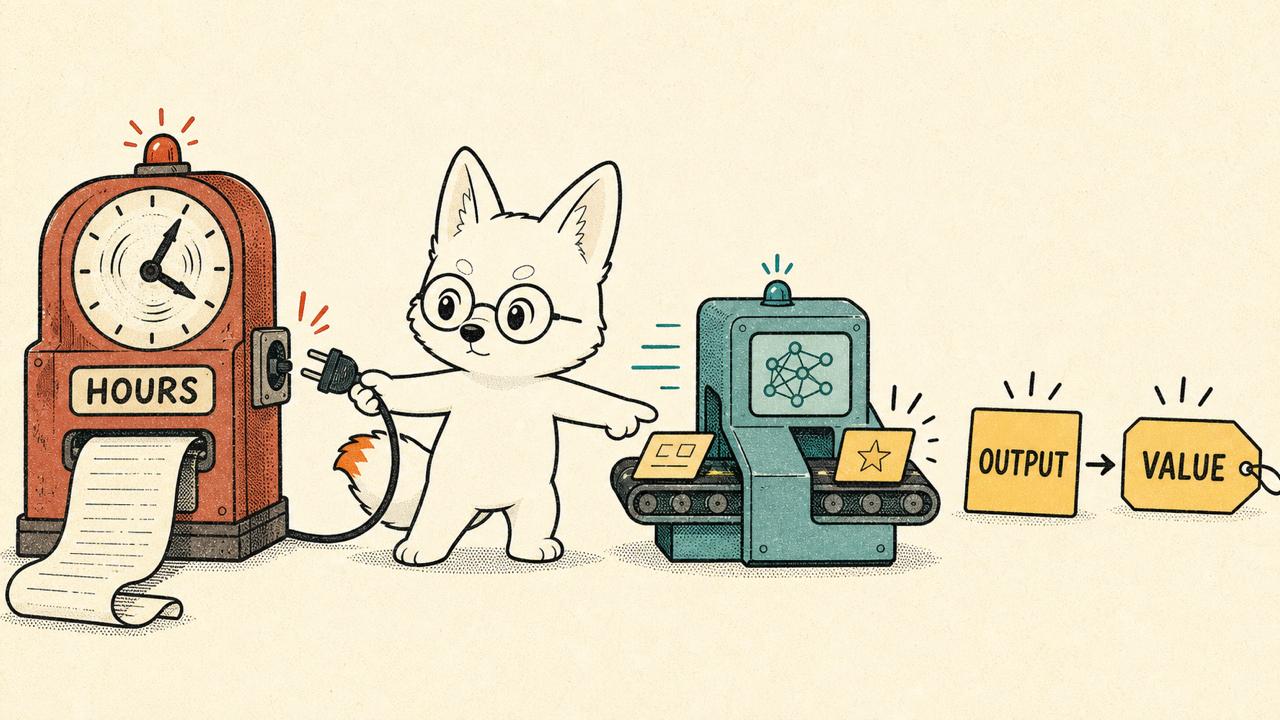
AI does not make agencies faster.
It makes hourly billing dishonest.
The conversation inside most marketing agencies right now goes something like this: “AI lets us do in five hours what used to take twenty. So we can take on more clients.”
The teams having that conversation are treating AI as a productivity lever.
They are missing the bigger problem.
Because if you are billing by the hour, you have just quietly made your pricing model dishonest.
Here is what most people believe.
AI makes agencies more efficient. Clients get faster turnaround. Everyone wins. A few agencies pass some savings on. Most keep the margin. Normal business, just optimised.
That sounds clean until you ask what the client is actually buying.
Marketing School ran an episode this week ranking the AI tools that actually matter for marketers in 2026: Hermes, OpenClaw, Codex, Claude Code, HeyGen, Beehiiv and the rest of the new operator stack.
The practical tool discussion was useful.
But the line that matters more was not about which logo won the tier list. It was the observation that selling AI services feels completely different from selling agency work.
That is not a branding observation.
It is a structural one.
When AI compresses a twenty-hour deliverable into five hours, the hour is no longer the unit of value. The work was not worth twenty hours because someone happened to spend twenty hours doing it. It was priced that way because twenty hours used to be a rough proxy for the expertise, judgement and effort required to get it right.
AI breaks the proxy.
The output still has value to the client. Sometimes more value, because it arrives faster and can be iterated more often. But the time spent producing it is no longer a reliable measure of that value.
Hourly billing smuggled in a false assumption: time equals value.
For decades, that assumption was close enough to be functional.
AI has made it obviously wrong.
Right now, every agency pricing on time spent is trapped in one of two bad positions.
Either it keeps the margin and continues telling clients a story about hours that no longer matches how the work gets made.
Or it passes the time saving straight through and destroys its own revenue.
Neither is sustainable.
The agencies that figure this out first will not just be more profitable. They will be more honest.
And clients will eventually be able to tell the difference.
The new model is already visible.
Pricing guides published this year are full of the same signal. AI agency pricing is shifting toward retainers, usage-based tiers, hybrid models, value-based projects and performance-linked work.
Digital Agency Network puts AI SEO retainers in the $2,000 to $20,000+ per month range, with automation builds, monitoring retainers and consulting packages sitting around different tiers depending on complexity.
Digital Applied makes the same point from the agency side: hourly billing loses ground when AI compresses execution. Their suggested models are AI readiness audits, agent setup fees, monthly agent licences, hybrid AI ops retainers and outcome-based pricing.
The exact numbers matter less than the direction.
The market is moving away from “we spent X hours” and toward “we run X capability”.
That shift matters more than any individual price point.
When you sell a capability, you are not selling a timesheet. The client is not buying hours from you any more than they are buying hours from their broadband provider. They are buying reliable output from a system that exists to serve a specific commercial goal.
That is the right frame for AI-native agency work.
Not “we do your marketing”.
“We install and operate the marketing function your business needs.”
That can include strategy. It can include content. It can include paid media. It can include agent workflows, model routing, CRM analysis, reporting, research, campaign operations and sales follow-up.
But the unit is not the hour.
The unit is the operating function.
This is how we think about it at Foundry.
The conversation is not “how many hours will this take?”
It is “what does the marketing function need to do, and what does it cost to run it properly?”
That sounds like a small language change. It is not.
It changes the entire commercial model.
Token costs, model routing, agent workflows, QA loops, prompt libraries, knowledge bases, monitoring and review cadence are operational levers. They matter. They affect margin, reliability and quality.
But they are not the billable unit the client should be asked to care about.
The client does not need a breakdown of every model call any more than they need to inspect every line of server logging on a website.
They need to know the system is working.
They need to know what it produces.
They need to know what it improves.
They need to know what it costs to keep running.
And they need to know the agency is not pretending that ten minutes of AI-assisted work is still two billable hours because the old rate card says so.
That is the trust problem.
AI did not kill agency value.
It killed lazy agency pricing.
This matters for agency owners now, not in some theoretical future.
Look at your last three client invoices.
If they are still denominated in hours, you have a repricing conversation to have. Not because you are leaving money on the table, although you might be. Because the model itself is telling clients the wrong story about what you are worth.
Your value is not your calendar.
It is your judgement, your taste, your operating system, your ability to turn messy inputs into useful commercial work, and your ability to keep that system improving over time.
AI makes that more valuable, not less.
But only if you stop pricing it like labour.
If you are a marketing buyer evaluating agencies, ask one simple question:
How do you price AI-assisted work?
An agency that can answer clearly has probably done the thinking.
An agency that dodges the question is either unaware of the shift or hoping you will not notice it yet.
The agencies that thrive through this will not be the ones fastest at using AI.
Speed is table stakes now.
The winners will be the agencies that know what they are actually selling.
Time was never the product.
It was just the only thing that was easy to measure.
Source signals:
- Marketing School episode referenced in the draft signal: The Best AI Tools for Marketing in 2026
- Digital Agency Network on 2026 AI agency pricing, retainer ranges and hybrid pricing models: AI Agency Pricing Guide 2026
- Digital Applied on hourly billing losing ground, AI ops retainers, outcome-based pricing and agent licensing: AI Agency Services Pricing: Strategies for 2026
Jason Sibley is the founder of Cleo, a post-agency marketing and AI company. JasonVsTheNoise is where he writes about what is actually happening with AI, marketing, and how businesses should be thinking about both.