Insight / signal
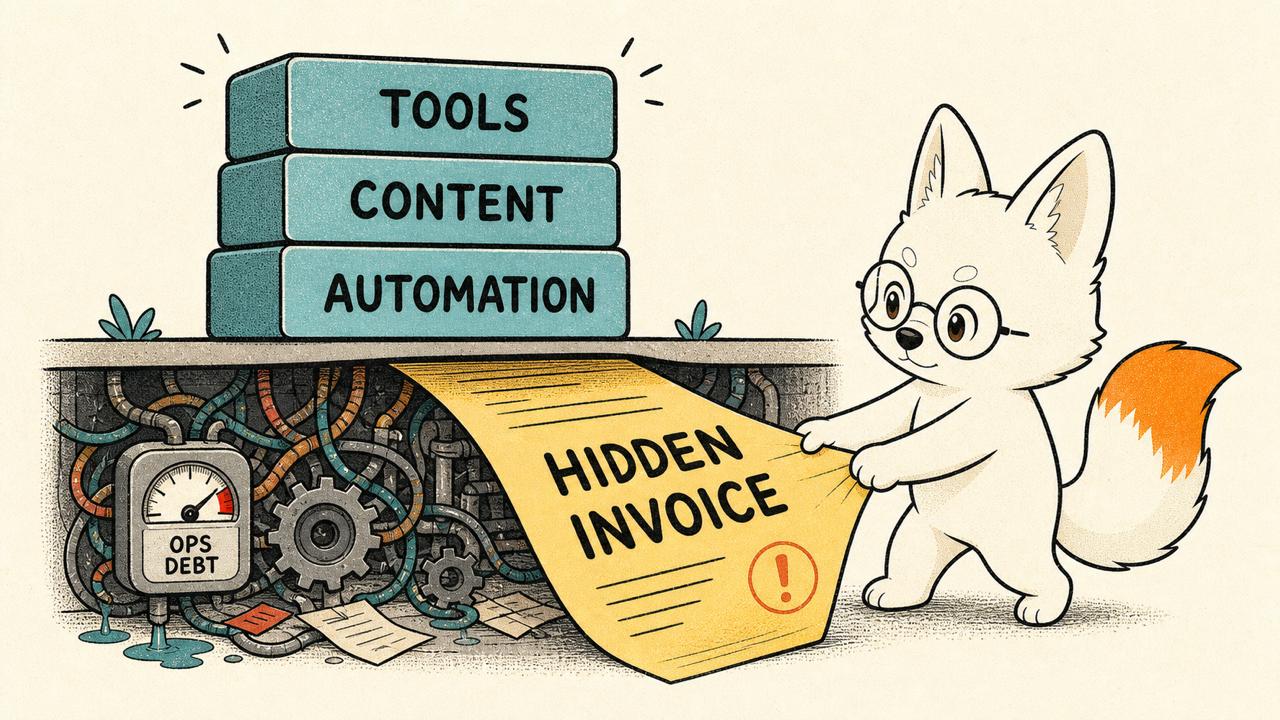
Your AI marketing stack has a hidden invoice you have not seen yet
AI costs are moving from flat subscription psychology to metered operations, and most marketing teams are not measuring what their agents consume.
A CFO at a tech company asked Claude to review how it was running a daily email automation.
Not the copy. The process.
Claude looked at the workflow it was part of, found the waste, and cut token usage by 80%. WIRED reported the story this week. It should make every marketing team with a quietly growing AI stack sit up a little straighter.
Because the flat-rate era trained everyone badly.
For the past two years, AI felt almost free. You paid a subscription. You got access. You wrote emails, briefs, landing pages, sales follow-ups and social posts. The cost felt abstract, because it was buried in someone else’s infrastructure bill.
That is fine for personal use.
It is not fine once the work becomes automated.
Agents do not just answer a prompt. They read context. They call tools. They inspect files. They retry failures. They summarise intermediate steps. They carry history forward. They sometimes wander around the task because nobody gave them a clear stop condition.
All of that costs tokens.
Not in theory. In the invoice.
Axios reported in May that one AI consultant had seen a client spend half a billion dollars in a single month after failing to set proper limits on Claude usage. Treat the exact number as a reported cautionary example, not a normal benchmark. But that is the point. The extreme example shows the shape of the problem before it reaches ordinary teams.
The received wisdom is still, “AI tools are cheap.”
That is only true when the human is the rate limit.
The moment you have agents running daily workflows, the economics change. A marketing assistant that drafts one email is not the same thing as an agent loop that checks a CRM, reads old campaign notes, searches the web, writes three variants, checks brand rules, asks another model to review it, rewrites the output, logs the result, and does that again tomorrow.
Same category of tool. Completely different cost model.
The real problem is not the cost. It is the invisibility.
Marketing teams are building AI workflows the same way they built software integrations five years ago. Bolt a tool here. Connect an API there. Add a Zap. Add a model. Add a chat interface. Assume it scales like SaaS.
But tokens are not a seat licence. They are closer to electricity.
Every run consumes something. Every extra context file consumes something. Every unnecessary tool definition consumes something. Every retry consumes something. The bill arrives after the work has already happened.
Autonomous agents make this worse because they hide the machinery. A human sees the final answer. The system sees the tool calls, failed branches, retries, long prompts, stale context and repeated file reads that produced it.
That hidden machinery matters for quality as much as cost.
When you overload an agent with too many jobs, too many context files and too many tools, it starts dropping the thread before the invoice gets interesting. The output gets vaguer. The agent asks for things it already has. It retries work it already did. Then the cost goes up because it is compensating for its own confusion.
That is the stupidest version of AI spend: paying more for worse work.
Unblocked published a useful benchmark this month. In a controlled test, an agent given curated context used 42% fewer tokens and made 64% fewer tool calls than the same agent dumping context into the window.
That is not a marginal saving. That is the operating model.
Context is not storage. It is budget.
This is the bit marketing teams need to grasp quickly.
The old question was, “Can AI help us make more stuff?”
The better question is, “What does each completed workflow cost us?”
Not each prompt. Not each model call. Each completed workflow.
What does it cost to draft and approve a newsletter? What does it cost to turn a webinar into three posts and an email? What does it cost to monitor competitors for a week? What does it cost to refresh product page copy across a site? What does it cost to produce one useful sales follow-up from real CRM context?
If nobody can answer that, the team is not running an AI marketing system. It is running a pile of clever demos with no meter attached.
This is why model selection by habit is such a tax.
There is no world where every summary, rewrite, classification or briefing job needs the most expensive model available. Some jobs need a frontier model because judgement, nuance or risk matter. Many do not. A short campaign recap does not need the same model as a strategic account plan. A tagged support note does not need the same model as a founder essay. A first-pass brief summary does not need the same model as a board memo.
Use the strong model where the work needs strength.
Use the cheap model where the work is cheap.
That sounds obvious. Most teams still do not do it.
The Marketing School episode this week ranked agent tools marketers are testing now: Hermes, OpenClaw, Codex, Claude Code and the rest of the new operator layer. The useful signal was not which logo won the tier list. The useful signal was that marketers are moving from chat to agents before they have learned agent economics.
That is the dangerous gap.
Chat hides bad habits because the human is still steering.
Agents scale bad habits because they can run without you watching every step.
So the work now is not “add AI”. That phase is done. The work is instrumenting it.
Audit what the agent actually does. Count tool calls. Count context loads. Count retries. Log model choice. Track cost per workflow. Add stop conditions. Prune context. Route simple tasks down to cheaper models. Cache stable instructions. Keep expensive reasoning for the work where expensive reasoning actually changes the outcome.
And, slightly ironically, ask the AI to audit itself.
Where are you using more context than you need? Which tools are loaded but unused? Which steps repeat? Which prompts are too long? Which outputs could be handled by a cheaper model? Which workflow has the worst cost per useful result?
The CFO in the WIRED story was not doing something exotic. He asked the system to look at its own process.
That is a habit every AI-heavy marketing team should steal.
AI tools are not going to get cheaper as they get more capable. The economics will keep moving in one direction. The marketing teams that build the habit of measuring what they are consuming now, before the invoices get scary, will have a durable operational advantage over the ones who find out the hard way.
The flat-rate era was useful. It got us here. But running a serious AI marketing operation on “I do not really track costs” is the same as running a paid media budget without conversion tracking.
It worked until it did not.
The most expensive AI tool is not the one with the highest subscription price.
It is the one running quietly in the background that nobody is watching.
Source signals:
- WIRED on Claude token usage and the 80% optimisation example: Pretty Crazy Token Usage Is Testing Bosses’ Bet on AI
- Axios on enterprise AI cost shock and the reported half-billion-dollar Claude example: Corporate America enters its AI reckoning
- Unblocked on curated context reducing token usage and tool calls: Cut AI Token Costs 50-90%: 7 Techniques
- Marketing School episode referenced in the draft signal: The Best AI Tools for Marketing in 2026
Jason Sibley is the founder of Cleo, a post-agency marketing and AI company. JasonVsTheNoise is where he writes about what is actually happening with AI, marketing, and how businesses should be thinking about both.